

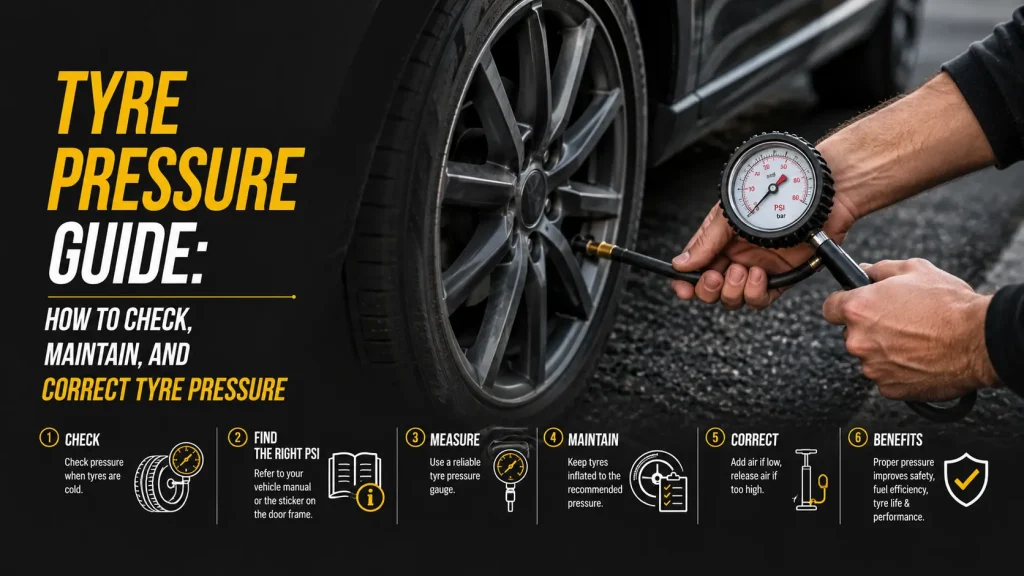
Tyre pressure is one of those things every driver knows they should check, and most don’t. It takes about five minutes with a decent gauge, and it affects almost everything about how a car drives, from grip and braking to fuel bills and tyre life. This guide covers what tyre pressure actually is, where to find the correct figure for your vehicle, and how to check and correct it properly, without the usual guesswork.
Quick Answer
The correct tyre pressure for your vehicle is the figure specified by the manufacturer, usually shown on a label inside the driver’s door frame, on the fuel filler flap, or in the owner’s handbook. Check pressures at least once a month using a reliable gauge, ideally when the tyres are cold, and adjust them to match the recommended value. Never rely on the maximum pressure printed on the tyre sidewall.
Key Takeaways
- Recommended pressure is set by the vehicle manufacturer, not the tyre brand.
- Always check when tyres are cold, before driving or after the car has been sat for a few hours.
- Check every month and before long journeys, including the spare.
- Underinflation and overinflation both cause problems, just different ones.
- A tyre that keeps losing pressure usually means a puncture, valve fault, or rim issue that needs inspecting.
What Tyre Pressure Actually Is
Tyre pressure is the amount of compressed air inside the tyre, measured in either PSI (pounds per square inch) or bar. The air is what supports the weight of the vehicle. The rubber itself is flexible; without the right pressure inside, the tyre can’t hold its proper shape under load.
Get it right and the tyre wears evenly, grips as designed, and lasts something close to its expected life. Get it wrong, and pretty much every part of how the car drives suffers, quietly, until you notice the tread is uneven or the fuel gauge is dropping faster than it should.
Finding Your Vehicle’s Recommended Pressure
Here’s the thing plenty of drivers get wrong: the big number on the tyre sidewall is not your recommended pressure. That figure is the maximum the tyre can safely hold, not what your car actually needs.
The correct pressure is set by the vehicle manufacturer, and you can usually find it in one of these spots:
- A label inside the driver’s door frame or door pillar
- The fuel filler cap or flap
- Inside the glovebox
- The vehicle owner’s handbook
Most vehicles list two figures: one for normal driving and one for a fully loaded car. Some also give front and rear pressures separately, since the load isn’t the same at both ends.
PSI and Bar: What the Numbers Mean
Both PSI and bar measure air pressure, just in different units. PSI is the older imperial unit and still shows up on plenty of UK forecourt gauges. Bar is metric, and most modern cars display both.
Rough conversion: 1 bar is about 14.5 PSI. So a car recommended at 2.2 bar sits at roughly 32 PSI. You don’t have to memorise this, most decent gauges show both.
How to Check Tyre Pressure Step by Step
The process itself is straightforward once you’ve done it once or twice.
- Find your recommended pressure using the label or handbook.
- Make sure the tyres are cold, ideally before you’ve driven anywhere.
- Unscrew the valve cap and put it somewhere you won’t lose it.
- Press the gauge firmly onto the valve. No hissing means a good seal.
- Read the gauge and compare it with the recommended figure.
- Add air if the reading is low, release air if it’s too high.
- Recheck the pressure after adjusting.
- Screw the valve cap back on.
- Repeat for every tyre, and the spare.
Digital gauges tend to be more accurate than the old dial types, but any working gauge is better than a good guess.
Why Cold Tyres Matter
Tyres warm up as you drive, and warm air expands. That means a hot tyre reads higher than the same tyre cold, even though nothing about the actual amount of air has changed.
Manufacturer figures are always for cold tyres. In practice, that means the vehicle has been sat for at least three hours, or driven less than a mile or two. Top up at a service station after a long motorway run and you’ll end up under the recommended pressure once the tyres cool.
Adding and Releasing Air
If pressure is below the recommended figure, add air in short bursts and check between each one. It’s easy to overshoot with forecourt pumps. If pressure is too high, press the small pin in the centre of the valve stem to release a bit at a time.
Modern petrol station air pumps let you set a target pressure and inflate automatically, which speeds the whole thing up. Just double-check whether the unit is set to PSI or bar before you start.
How Often Should You Check?
At minimum, once a month. Always before long journeys. Also worth checking:
- After hitting a kerb or pothole
- When the weather turns significantly colder or warmer
- Before towing or carrying a heavy load
- After the car has been sat unused for weeks
Tyres slowly lose air through natural permeation, typically one to two PSI per month even with no leak. A quick monthly check catches this before it becomes a real problem. If you’re not sure what to do when things go badly wrong on the driveway, our guide on what to do when you find a flat tyre at home walks through the sensible steps.
Underinflation vs Overinflation
Both are bad news, just in different ways.
| Situation | What Happens |
|---|---|
| Underinflation | Outside edges of the tread wear faster, sidewalls flex more, tyres run hotter, braking distances increase, fuel consumption rises, blowout risk goes up. |
| Overinflation | Middle of the tread wears faster, contact patch shrinks, grip drops, ride feels harsh, tyre is more vulnerable to pothole and kerb damage. |
| Correct pressure | Even wear across the tread, proper grip, safer braking, better fuel economy, expected tyre life. |
Underinflation is by far the more common problem in the UK. Michelin’s long-running Fill Up With Air campaign has found that a large share of cars on British roads are driving on underinflated tyres, and a smaller but significant slice are seriously underinflated.
Cold Weather and Tyre Pressure
Cold air is denser, so pressure inside the tyre drops as the temperature outside falls. As a rough rule, tyres lose roughly 1 to 2 PSI for every 10°C drop in temperature. That means a set of tyres inflated correctly in September can quite easily be underinflated by December.
If your dashboard warning light comes on during the first proper cold snap of the year, it’s often the temperature rather than a puncture. Still, check every tyre, top up where needed, and see whether it comes back on again once you’ve driven a bit.
Vehicle Load and Pressure Adjustments
Manufacturers usually list a higher pressure figure for when the vehicle is carrying a heavy load, which covers passengers, luggage, or a towed trailer. Ignore this and the tyres flex too much, wear faster, and run hotter than they should.
If you’re heading off on holiday with a full boot and a roof box on top, spend two minutes checking the label and setting the loaded pressures before you set off. Same goes for van drivers carrying a full working load.
What TPMS Does (and What It Doesn’t)
TPMS stands for Tyre Pressure Monitoring System. It’s been mandatory on most new cars sold in the UK and EU since November 2014, so most cars on the road today have one.
The system monitors tyre pressure and warns you, usually via a dashboard light, when a tyre drops significantly below its target. Useful, but not a substitute for manual checks. TPMS is generally required to trigger when pressure has fallen roughly 20-25% below the recommended value, which is already low enough to affect handling. Sensors can also fail with age, particularly the direct type that sits inside the wheel.
Think of TPMS as a safety net for sudden drops, not a replacement for the monthly check.
When One Tyre Keeps Losing Pressure
A tyre that needs topping up every few days isn’t normal. Common causes include:
- A puncture from a nail, screw, or similar object in the tread
- A perished, damaged, or corroded valve
- A poor seal between the tyre bead and the wheel rim (a “bead leak”)
- A cracked or corroded alloy wheel
Any of these need proper inspection. Repeatedly reinflating a slowly leaking tyre without fixing the cause is really just relying on luck. A professional puncture repair and inspection can usually identify the issue in a few minutes. Ignore it and a repairable problem can turn into a full replacement, or worse, a failure at the wrong moment.
There’s more detail in our guide on what causes slow punctures, which explains how to spot one before it strands you.
Don’t Forget the Spare
Most people never look at their spare until they need it, which is precisely when they discover it’s flat, seized to the mount, or years past its useful life. Spares lose pressure just like the tyres you’re driving on.
Space-saver spares often need much higher pressures than regular tyres, sometimes 60 PSI or more. Check the number on the spare itself or in the handbook. If your car has a repair kit instead of a spare, check that too, the sealant has a shelf life.
When to Call a Professional
Most tyre pressure checks and top-ups are DIY jobs. But there are situations where getting a professional involved makes sense:
- A tyre repeatedly loses pressure despite topping up
- You spot damage to the sidewall, tread, or valve
- The TPMS light stays on after correct inflation
- You’ve hit a serious pothole and want the tyre and wheel checked
- One or more tyres show clear signs of uneven wear
If you’re not sure whether a tyre is still safe to drive on, don’t guess. A mobile tyre fitting service can come to your home or workplace, inspect the tyre properly, and either repair it or fit a replacement on the spot, so you’re not driving on something you shouldn’t be.
For further reading on tyre safety generally, the TyreSafe website is a good independent UK resource covering pressure, tread, and legal requirements in a lot more depth.