

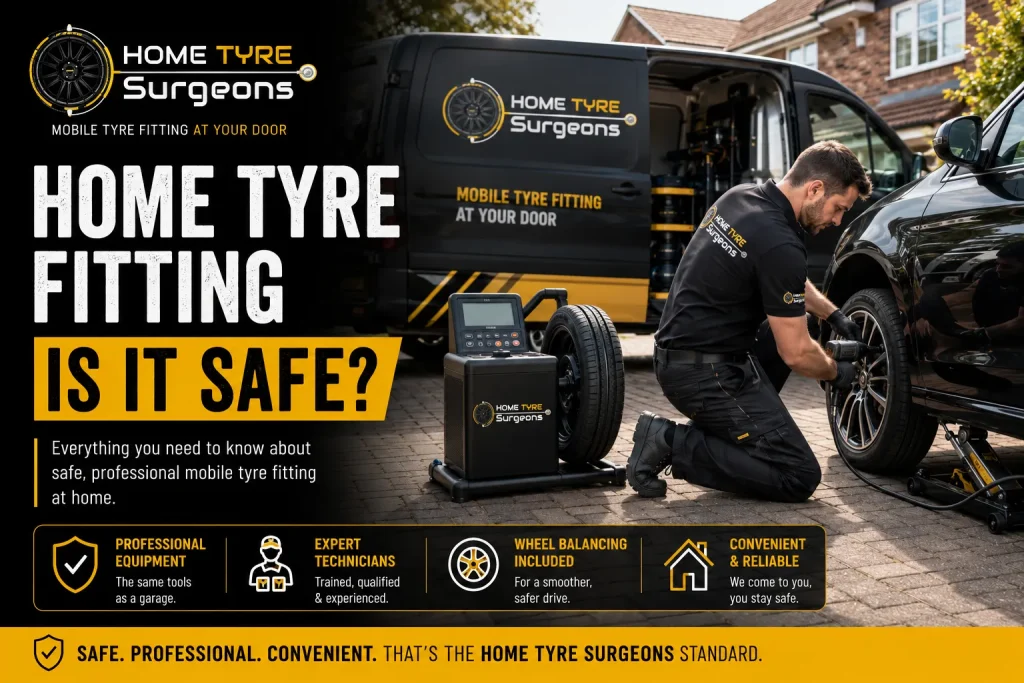
It’s a fair question, honestly. The idea of someone changing your tyres on your driveway rather than inside a proper garage feels a bit odd at first. But mobile tyre fitting has grown significantly across the UK, and for most drivers, the safety concern isn’t really about the location. It’s about the technician, the equipment, and whether the job gets done properly.
Quick Answer
Yes, home tyre fitting is safe, provided it’s carried out by a qualified technician using professional-grade equipment. The fitting process itself, whether done in a garage forecourt or on your driveway, follows the same procedures: tyre removal, inspection, fitting, torque tightening, and wheel balancing. What matters is who’s doing the work and how. A reputable mobile service brings the same tools a garage uses, travels to you, and completes the job to the same standards. The location is secondary.
Key Takeaways
- Mobile tyre fitting uses the same professional equipment and techniques as a fixed garage
- Puncture repairs must comply with British Standard BS AU 159 to be considered safe and legal
- Technicians should check wheel torque settings and perform wheel balancing after every fitting
- A flat, stable surface is required for safe lifting; good services will ask to move the vehicle if needed
- Sidewall damage and large punctures cannot be safely repaired, regardless of where you are
- The safety of the job depends on the technician’s training, not the address
What Actually Happens During a Mobile Tyre Fit
People sometimes picture a mobile technician wrestling with a tyre on a jack using hand tools from a boot. It’s not like that. Professional mobile units carry hydraulic jacks, torque wrenches, and fully portable tyre changing and balancing machines. The whole process looks a lot like what you’d see in a tyre bay, just without the walls around it.
When a technician arrives, they start with a vehicle lift on stable ground, remove the wheel, break the bead on the old tyre, fit the new one, seat the bead properly, rebalance the wheel, and refit it with the correct torque. That’s the sequence whether you’re in a Halfords forecourt or your driveway in Streatham. The steps don’t change.
Wheel balancing matters more than most drivers realise. A tyre fitted without balancing can cause vibrations at motorway speeds and uneven wear within a few thousand miles. Any competent mobile service includes this as standard.
The Surface Question
This is the most common safety variable for mobile fitting. Lifting a car safely requires a firm, level surface. Soft ground, steep inclines, or loose gravel can compromise a jack’s stability. It’s not complicated, but it does need to be right.
Good mobile technicians will assess the surface before lifting. If your driveway is on a slope or the surface isn’t suitable, a professional will ask to move the vehicle slightly rather than just getting on with it. That assessment is part of the job. If a technician never mentions the surface at all, that’s worth noting.
Most residential driveways and roads work perfectly well. Car parks, workplace surfaces, and most roadside locations are generally fine too.
Puncture Repairs: When Safe Means Following the Standard
This is worth spending a moment on. Not all tyre repairs are created equal, and the UK has a clear British Standard for this, BS AU 159, which defines exactly what can and cannot be repaired safely.
Under BS AU 159, a puncture is only repairable if it sits within the central tread area (roughly the central three-quarters of the tread width), the penetration is no more than 6mm in diameter, the tyre hasn’t been driven on while flat, and there’s no structural damage. The repair method must use a combination plug-patch from inside the tyre. External plug-only repairs, liquid sealants, and inner tubes fitted to tubeless tyres don’t meet the standard.
Sidewall damage? That’s a replacement, full stop. No reputable technician will patch a sidewall, regardless of how small the damage looks.
If you want to check whether a repair service follows BS AU 159, just ask before booking. Any professional service should confirm it without hesitation. According to the British Tyre Manufacturers’ Association, tyres repaired to this standard can operate at their original speed and load capabilities.
What to Look for in a Mobile Tyre Technician
Safe home tyre fitting starts with choosing the right service. A few things worth checking:
| What to Check | What a Good Service Provides |
| Equipment | Portable balancing machine, hydraulic jack, torque wrench |
| Repair standard | Confirms BS AU 159 compliance for puncture repairs |
| Wheel balancing | Included as standard with every fit |
| Tyre brands | Recognisable brands including Michelin, Continental, Pirelli, Bridgestone |
| Surface check | Assesses your location before lifting |
| Valve replacement | New valves fitted with new tyres |
Valve replacement is one that slips under the radar. Old valves can fail and cause slow leaks. Any tyre fitting, mobile or otherwise, should include a new valve when fitting new rubber.
Common Concerns, Addressed Directly
“Can they really balance a tyre properly without a garage?” Yes. Modern portable balancing machines are accurate and widely used by professional mobile services across the UK. The technology has been around long enough that this isn’t a concern worth losing sleep over.
“What if something goes wrong?” A reputable service will carry insurance and stand behind their work. Ask about guarantees before you book. If a technician won’t give you a straight answer on this, that tells you something.
“Is it safe for run-flat tyres and performance vehicles?” This depends on the service. Some mobile operators don’t carry the specialist equipment needed for certain run-flat fitments or staggered setups on performance cars. Worth confirming when you book if you drive an SUV, 4×4, or performance vehicle.
If you want to understand more about what a professional home tyre fitting involves from arrival to completion, it helps to know the process before your technician shows up.
The DIY Comparison
It’s worth saying: home tyre fitting by a professional is not the same as changing your own tyres. DIY tyre changes using a spare wheel are fine in an emergency. But fitting a new tyre onto a rim, seating the bead correctly, and balancing the wheel properly requires equipment most drivers don’t own and training most haven’t had.
This is partly why the question about safety comes up at all. People conflate “tyre change at home” with a roadside emergency change. They’re different things. A home tyre repair carried out by a trained technician with proper kit is not a workaround. It’s the full service, just delivered differently.
Understanding what causes slow punctures is also worth reading before your appointment, especially if you’re not sure whether you need a repair or a full replacement.
When Mobile Fitting Is the Right Choice
Honestly, for most routine tyre changes and straightforward puncture repairs, mobile fitting makes sense. It saves you a trip, and the quality of the work shouldn’t differ from a garage visit, assuming the technician is experienced and properly equipped.
Where it gets slightly more complex is with certain specialist vehicles, unusual rim sizes, or tyre types like asymmetric performance tyres that need careful fitment orientation. These aren’t dealbreakers, but it’s worth confirming your vehicle details when you book rather than after the technician arrives.
For emergency situations, a flat at home or a slow puncture discovered overnight, mobile tyre fitting time at home is worth knowing before you need it. Response times and what to expect will vary by service and area, but most good operators will give you a realistic window upfront.
The Honest Summary
Home tyre fitting is safe. The location, a driveway versus a garage bay, matters far less than the quality of the technician and the equipment they bring. British Standard BS AU 159 exists precisely to ensure repairs meet a consistent safety threshold regardless of where the work is done.
The drivers I’d say should think twice are those with very specialised vehicles who haven’t confirmed the mobile operator can handle their setup. Everyone else? A qualified mobile technician with proper equipment is as good as a garage visit. Often, given you don’t have to go anywhere, it’s better.